
The Federal Circuit Raises the Section 112 Stakes for Chemical Structures in Seagen v. Daiichi
On December 2, 2025, the U.S. Court of Appeals for the Federal Circuit issued a precedential decision in Seagen Inc. v. Daiichi Sankyo Company Ltd., which further clarifies the amount of disclosure a US patent must contain to uphold claims covering a generic scope of chemical structures, especially in the realm of therapeutics. The patent at issue was Seagen’s U.S. Patent No. 10,808,039 (the ’039 patent), which relates to antibody-drug conjugates (ADCs). An ADC is characterized by an antibody that selectively binds a biological target and is attached to a therapeutic drug via a linker. The linker is designed to be cleaved at an appropriate time to ensure efficacy of the drug and avoid harm to healthy cells.
Previously, Seagen filed suit against Daiichi for infringement of claims 1 through 5, 9, and 10 of the ’039 patent in the U.S. District Court for the Eastern District of Texas, particularly over Daiichi’s U.S. Food and Drug Administration–approved ADC Enhertu. A jury had found that Daiichi did not prove any of the asserted claims to be invalid and willfully infringed at least one of the asserted claims. Seagen was awarded $41.8 million in damages and an 8% running royalty after the District Court denied Daiichi’s motion for judgment as a matter of law (JMOL) arguing, in part, that the asserted claims were invalid for a lack of written description and enablement under section 112(a) of the Patent Act (35 U.S. Code Title 35). On appeal, the Federal Circuit reversed and ruled the District Court erred in denying Daiichi’s motion for JMOL, agreeing with Daiichi that the claims of the ’039 patent are invalid. The Federal Circuit’s analysis focused on whether the required linker components and drug moiety of the claimed ADCs were sufficiently supported by an accompanying patent specification in accordance with the written description and enablement requirements of section 112(a).
Claims at Issue
Claim 1 of the ’039 patent, which the Federal Circuit found representative of the asserted claims, recites an ADC of the following formula:
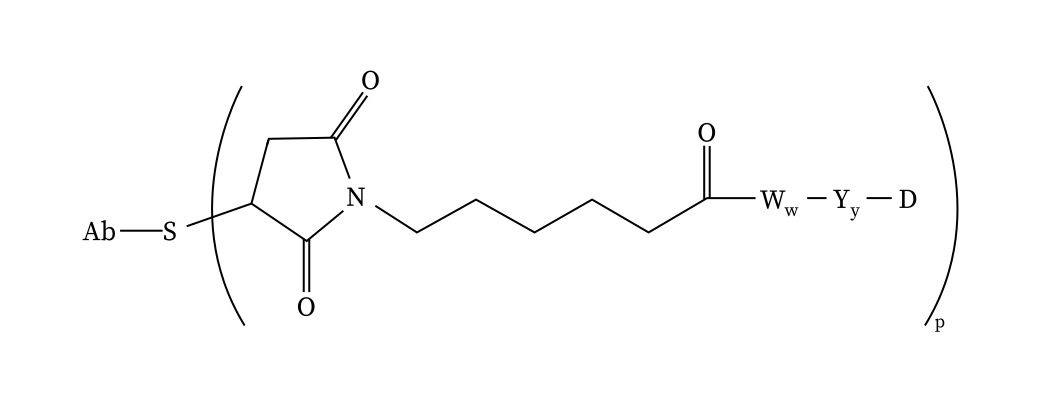
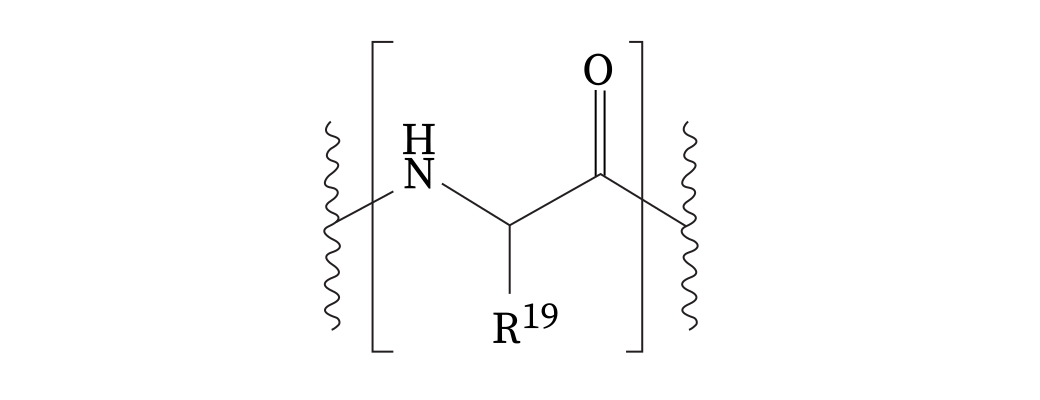
The boxed pieces in the image are the claim limitations analyzed by the Federal Circuit.
- Ww is a tetrapeptide component of the ADC’s linker, where each W group is an amino acid containing an R19 variable.
- When R19 is hydrogen, the peptide unit is the amino acid glycine (“gly” or “G”). When R19 is benzyl, the peptide unit is phenylalanine (“phe” or “F”). Thus, the claimed tetrapeptide is limited only to units of glycine or phenylalanine (a “gly-phe-only” tetrapeptide).
- Accounting for all possible isomerism in the amino acid units, the claim encompasses 81 tetrapeptides.
- On the other hand, the drug moiety “D” was construed to encompass any drug moiety in accordance with its plain meaning.
- The claimed ADCs are also characterized by a functional limitation “wherein the drug moiety is intracellularly cleaved in a patient from the antibody of the antibody-drug conjugate.”
Written Description
Enhertu was invented in 2011 and first publicly disclosed by Daiichi in 2015. Moreover, Enhertu contains gly-gly-phe-gly (GGFG), a gly-phe-only tetrapeptide, within the claim scope of the ’039 patent. And while Seagen filed the patent application resulting in the ’039 patent after Daiichi’s disclosure in July 2019, Seagen filed the case as a continuation application of a prior patent application filed in November 2004 (the 2004 application) to benefit from its priority date. In this regard, the key issue before the Federal Circuit was whether the claims of the ’039 patent derived enough written descriptive support from the 2004 application such that the ’039 patent could claim the November 2004 priority date and thus avoid Daiichi’s 2015 disclosure of Enhertu as invalidating prior art.
The Federal Circuit found that Seagen did not meet this requirement to retain priority, noting that the record was not supported by substantial evidence that the 2004 application provides sufficient written description for the claimed gly-phe-only tetrapeptide. In its analysis, the court assessed the level of written support in the 2004 application for the gly-phe-only tetrapeptides claimed by the ’039 patent. The court noted that the 2004 application did not explicitly describe a gly-phe-only tetrapeptide. Rather, it found that gly-phe-only tetrapeptides in the 2004 application were encompassed only by a broad description of tetrapeptides assembled from 39 different amino acids, amounting to more than 47 million distinct structures. This number was contrasted with the 81 gly-phe-only tetrapeptides encompassed by the ’039 patent, which the court notes are “merely an infinitesimal fraction of those peptides units generally included” by the more than 47 million of the 2004 application. The court refers to its prior decision in Novozymes A/S v. DuPont Nutrition Biosciences APS in finding that a “broad genus” like the one of the 2004 application, without anything more, provides inadequate written description for a “particular subgenus or species” encompassed by the claims of the ’039 patent.
To defend the ’039 patent and support derivation of a subgenus from an earlier-filed, broader genus, Seagen relied on precedent laid out by In re Driscoll. However, the Federal Circuit distinguished the 2004 application from the disclosure in Driscoll, noting that the 2004 application discloses “effectively countless peptide units,” which is “a far cry from the 14 moieties […] in Driscoll.” Further, the court found certain testimony to be counterproductive to Seagen’s position that gly-phe-only tetrapeptides were sufficiently described by the 2004 application. For example, the lead inventor of the 2004 application admitted first observing a gly-phe-only tetrapeptide in Enhertu, not in the 2004 application. Further, expert testimony offered by Seagen asserted that the 2004 application contained enough descriptive support (“blaze-marks”) for a skilled artisan to make a “straightforward leap” from a specific tetrapeptide containing leucine disclosed in the application (GFLG ) to one that is “all G and F.” However, the court found this testimony to be “self-defeating” as a skilled artisan should not be expected to make such a leap based on the disclosures of the specification. Instead, the court found that the expert “admits that a skilled artisan would not understand the inventors of the 2004 application to have ‘possession’ of GFFG ,” contrary to section 112(a).
Enablement
The Federal Circuit’s analysis of enablement centered on the quantity of experimentation required by the ’039 patent’s specification to make and use the full scope of the drug moiety “D” coupled with the functional requirement that “the drug moiety is intracellularly cleaved in a patient from the antibody of the antibody-drug conjugate.” The court found the asserted claims were not enabled by the ’039 patent, disagreeing with Seagen that the full scope of the claimed ADCs did not require undue experimentation. Applying the U.S. Supreme Court’s decision in Amgen v. Sanofi, the court found that the specification did not disclose a “quality common to every functional embodiment” contemplated by the claim. This was underscored by inventor testimony that emphasized the unpredictability of ADC science in which assays are needed to determine whether a specific ADC will succeed in intracellular cleavage. The ’039 patent was found to require a degree of experimentation that amounted to vast trial and error. From here, the court ruled that there was no substantial evidence that the claims of the ’039 patent were enabled.
Takeaways
The Federal Circuit’s decision is yet another addition to an evolving line of section 112 case law that raises the disclosure standards required to patent inventions in the life sciences, especially when the invention is defined by a chemical structure. It is expected to impact both the patentability and enforceability of broad generic claims for various types of therapeutics including small molecules and polypeptides, even if the generic scope relates to only a portion of the therapeutic product. The case also serves as a reminder of the distinct standards for written description (disclosure and possession of the invention) and enablement (quantity of experimentation required to practice the invention). A robust US patent strategy should account for these two separate requirements. When drafting patent applications, applicants should:
- Consider supplementing their broader generic disclosures with narrower “subgeneric” structures that more closely resemble the chemical compounds or moieties of interest, as opposed to providing only a broad genus that merely encompasses narrower structures.
- Consider including a set of working examples that represent how to make and use the scope of the claimed compounds or moieties. This includes, for example, synthetic procedures and assays used to assess biological activity.
- Carefully evaluate the need to include functional limitations in product claims, considering the effect such limitations could have on demonstrating enablement.
This case was also decided alongside Seagen’s appeal of a separate Patent Trial and Appeal Board (PTAB) Final Written Decision finding the ’039 patent to be invalid for lack of written description and enablement. In view of the parallel outcome in the District Court appeal, the Federal Circuit dismissed the PTAB appeal as moot.
This informational piece, which may be considered advertising under the ethical rules of certain jurisdictions, is provided on the understanding that it does not constitute the rendering of legal advice or other professional advice by Goodwin or its lawyers. Prior results do not guarantee similar outcomes.
Contacts
- Catherine McCarty

Catherine McCarty
PartnerCo-Chair, Intellectual Property - Gregory D. Gutierrez, Ph.D.

Gregory D. Gutierrez, Ph.D.
Associate