
What Makes an UPREIT Go-Private Different
I. Introduction
Over the course of 2025 and the first half of 2026, the market for take-privates of publicly traded real estate investment trusts (REITs) has been strong as private investment funds and other private players with available capital seek higher yields and transactions of a larger scale and a number of these REITs have been trading below net asset value. For REITs, these privatization transactions present both buyers and sellers with unique issues when the REIT involved has an UPREIT structure. While an UPREIT structure provides significant benefits to many REITs, in a take-private transaction, the limited partners represent an additional set of stakeholders to be considered, often with interests that differ from the holders of publicly traded stock. This article focuses on the issues that are particular to UPREIT go-privates. For a more general discussion of REIT take-private transactions, see our other alerts.
II. UPREIT Basics
An umbrella partnership real estate investment trust, commonly known as an UPREIT, is a structure in which a REIT conducts substantially all of its operations and holds substantially all of its assets through an operating partnership (the “OP”). The REIT serves as the general partner of the OP1 and typically holds a majority of the equity interests in the OP, referred to as “OP units,” while outside limited partners who contributed properties to the UPREIT and insiders who may have contributed properties at the formation of the REIT or who have received profits interests in the UPREIT as part of their executive compensation hold the remaining OP units. The OP units are designed to be economically equivalent to the shares of REIT common stock. For example, each OP unit will receive the same amount of distributions per share as one share of REIT common stock, and the OP units’ customary exit right is fixed as the value of a REIT share on the public markets. This structure has become the dominant organizational form for publicly traded REITs; by some estimates, approximately 80-90% of public REITs are organized as UPREITs.
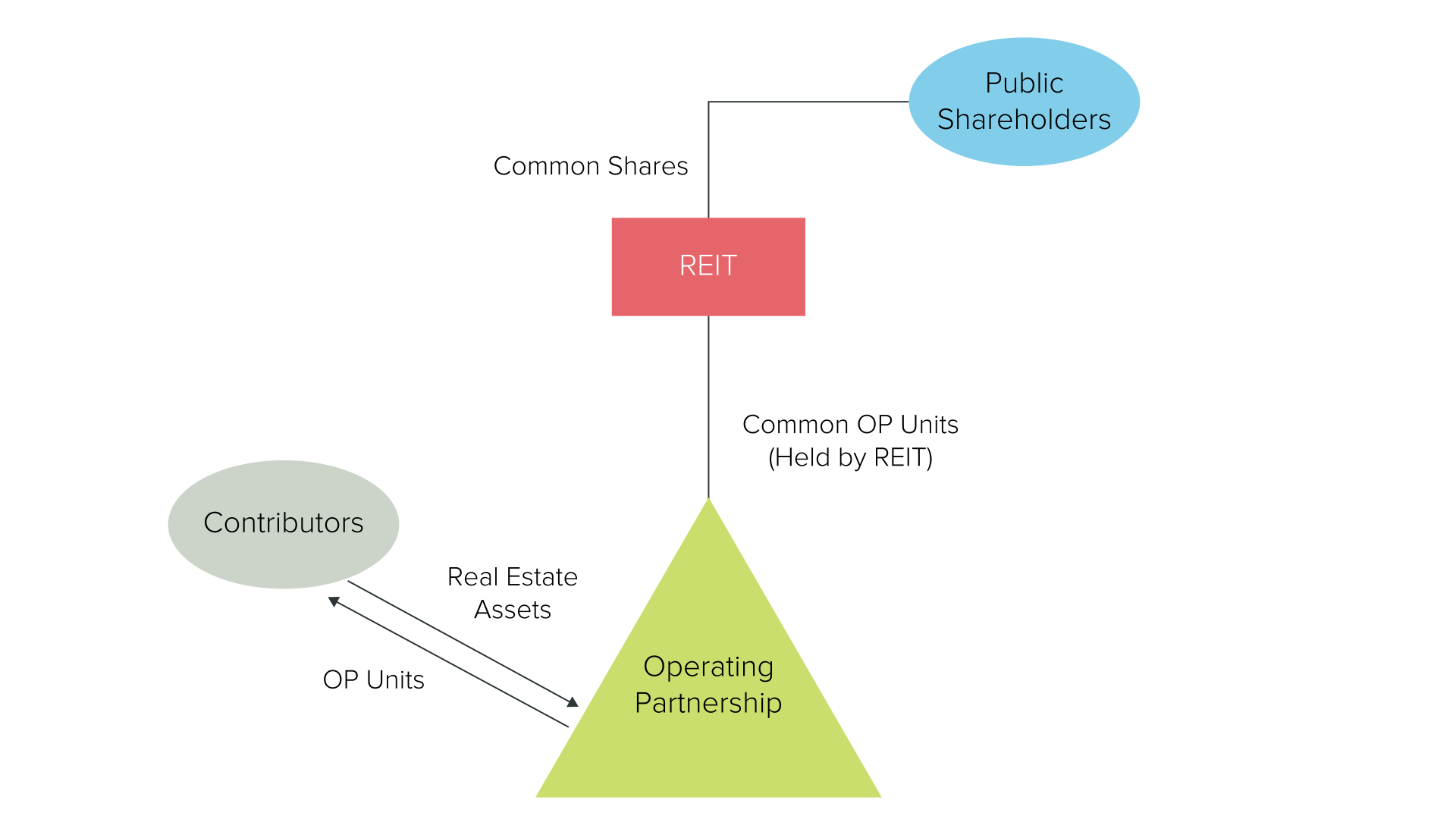
The UPREIT structure has two major benefits. First, property owners can contribute real estate to the OP in exchange for OP units rather than selling the property in a taxable transaction (both upon the original formation of the REIT’s portfolio and on an ongoing basis). Because such contributions are generally structured as tax-deferred exchanges under the Internal Revenue Code, the contributing property owner defers recognition of the built-in gain on the contributed property. This mechanism allows the REIT to acquire properties from owners who might otherwise be unwilling to sell and trigger the associated taxes. Second, many UPREITs use their OPs to issue long-term incentive plan (“LTIP”) units to key executives and other service providers. LTIP units function as a form of equity compensation and, once vested, are generally convertible into OP units. OP units, in turn, are exchangeable into publicly traded REIT shares on a one-for-one basis, so LTIP units provide a liquid form of incentive equity that generally has favorable tax treatment compared to other incentive-based equities issued by a public REIT.
The prevalence of the UPREIT structure has significant implications for take-private transactions involving public REITs. Unlike a conventional public company go-private, where the buyer's primary concern is negotiating a price acceptable to the public shareholders, an UPREIT go-private introduces an additional set of stakeholders whose interests must be taken into account: the OP limited partners. Corresponding to the two main benefits of the UPREIT structure, limited partners generally fall into two categories: property contributors who received OP units in tax-deferred exchanges and LTIP holders who received OP-level equity as incentive equity. Each group has economic interests and legal protections that differ from each other and from the public REIT shareholders and that can materially affect deal pricing, structure, and execution risk.
III. Considerations for Buyers
When considering a bid for a publicly traded UPREIT, potential buyers should first endeavor to understand the UPREIT structure and which group the limited partners fall into, what governance or blocking rights the limited partners might have, and the economic magnitude of the unitholder positions. Much of the information needed for buyer due diligence is not publicly available and, therefore, will only be shared once the parties have entered into a confidentiality agreement in connection with the transaction process.
The Terms of the Operating Partnership Agreement
A prospective buyer must start by carefully reviewing the OP's limited partnership agreement (the “LPA”). The LPA governs the respective rights and obligations of the general partner (typically the REIT) and the limited partners, and its terms will determine the extent to which the REIT, acting as general partner, can unilaterally effectuate or facilitate a go-private transaction and, conversely, the extent to which the limited partners have consent rights, put rights, or other mechanisms that could delay or impede the transaction. Key provisions to examine include any restrictions on mergers, consolidations, or sales of all or substantially all of the OP's assets; any requirements for limited partner approval of fundamental transactions; redemption and exchange rights; restrictions on general partner substitution (which often results from the merger transaction structure); and any provisions governing amendments to the LPA itself. A buyer that fails to account for these provisions risks encountering unexpected obstacles that may impact fundamental transaction structure at a late stage of the transaction.
Operating Partnership Agreements come in a variety of forms and can sometimes be unique, though most have coalesced around a set of market norms over time. One of the most common formulations for the provisions dealing with a merger of the associated REIT requires a vote of the outside limited partners unless the limited partners are offered the same merger consideration as the REIT shareholders. Thus, no separate vote is required if the transaction maintains the economic equivalence between one REIT share and one OP unit. The requirement also allows for the holders of OP units to be offered alternative consideration packages, something important when preserving tax benefits is at issue.
Tax Protection Agreements
“Property contributors” are individuals or entities that previously contributed real property to the OP in exchange for OP units in transactions designed to defer recognition of the built-in gain on the contributed assets. For these limited partners, the preservation of tax deferral is typically the paramount concern. A go-private transaction that forces a redemption or cash-out of their OP units, or that results in a disposition of the contributed properties, will likely trigger the recognition of that built-in gain. Such gain recognition could give rise to substantial and unexpected indemnity obligations of the OP to pay liquidated damages to these contributors to cover the contributors’ tax obligations.
Because deferral of gain is the central concern for many contributors to UPREIT OPs, which may include insiders, many contributors have required OPs to enter into tax protection agreements (TPAs) concurrently with their contributions. Under a typical TPA, the REIT (or the OP) agrees to indemnify the contributor against some or all of the tax liability that would arise if the OP were to dispose of the contributed property or take certain other actions in a manner that triggers recognition of the contributor's deferred gain. The specific terms of TPAs vary considerably. Damages may be measured on a “total tax” basis (i.e., the full amount of the tax on the triggered built-in gain) or on a “time-value-of-money” basis (i.e., the present value of the acceleration of the tax liability). TPAs typically have a finite term, most commonly ranging from five to ten years. Many TPAs also include debt protection covenants under which the OP agrees to maintain a minimum level of indebtedness allocable to the contributing partner, thereby preserving that partner’s ability to include a share of partnership liabilities in its outside basis and avoid setting off gain caused by the that partner not having enough debt allocated to cover its so-called “negative capital account.” Debt protection provisions of a TPA, if needed, are often the most complicated and heavily negotiated provisions in the TPA and are likely to be the most difficult for buyers to maintain without constraining their financial strategies going forward.
Importantly, most modern TPAs contain an exception providing that no indemnification is owed if the contributor is offered a reasonable opportunity to either maintain its existing OP limited partnership interest and existing tax protection or to “roll” its investment into a successor entity in a transaction that does not trigger gain recognition and preserves the existing tax protection. However, older TPAs may lack this roll-up exception, a gap that was at the center of the well-known Archstone litigation in which contributing partners asserted that the TPA was violated in connection with a change-of-control go-private transaction.
TPAs present a number of challenges for prospective M&A buyers. As a threshold matter, there is generally no way for an outside party to determine from publicly available information whether TPAs are in place, how damages are calculated under those agreements, or whether they include debt protection covenants, and the terms, including the expiration date, of such covenants. This information asymmetry underscores the need for robust tax diligence early in the transaction process. Once the buyer has identified the relevant TPAs, it must make a strategic decision: should the OP contributors be permitted to remain as limited partners in the surviving entity (a “roll”), or should they be forced out as part of the transaction, creating what could be a large liquidated damages cost to the transaction which is not always easy to calculate and may come at a premium cost?
Each approach carries risk. Forcing out the contributors may trigger TPA indemnification obligations, which could be substantial depending on the built-in gain, the damages methodology, and the remaining term of the TPA. On the other hand, offering a roll opportunity requires the buyer to maintain and/or establish a more complex capital structure going forward, assume any remaining obligations under the TPAs, and may not fully insulate the buyer from liability. Even if offered the chance to roll, contributors may nonetheless assert that the transaction constitutes a breach of the TPAs, leaving the buyer to manage the resulting litigation risk.2 Careful structuring and, where possible, negotiated releases or amendments to the TPAs are essential to managing these exposures. These are all factors that may impact transaction structuring and should, therefore, be addressed and negotiated as early as possible in negotiated transaction process discussions.
LTIP Holders
The second key constituency is LTIP holders, typically senior executives and other key employees who have received LTIP units as a form of incentive equity compensation. LTIP units are economically comparable to restricted stock: once vested, they are generally convertible into OP units and, in turn, into publicly traded REIT shares, providing the holder with a highly liquid form of equity.
Because LTIP holders are generally upper-tier executives, a buyer that intends to retain the existing management team following the go-private will need to be particularly sensitive to their interests. Unlike property contributors, LTIP holders tend to prioritize liquidity over tax deferral; many may prefer to be cashed out in the go-private transaction rather than rolling their interests into an illiquid (or less liquid) successor vehicle. That said, buyers should be aware that LTIP holders may need to satisfy a minimum holding period (often three years) in order to qualify for long-term capital gains treatment on the disposition of their units, and the timing of the transaction relative to those holding periods may influence their preferences. Following the closing of the go-private, the buyer will have the flexibility to design a new incentive equity program for retained management in line with prevailing private REIT market practices. It is possible that these senior executives and other key employees may have also contributed properties to the OP at the time of REIT formation, which further complicates matters.
IV. Practical Considerations for Transaction Due Diligence
Because the REIT is a public entity but the OP is not, much of the information that would be publicly available for a typical public company cannot be determined for an UPREIT without it being provided as part of the transaction due diligence process. The target company must therefore decide how much and when to share in the transaction negotiation process, which often will depend on the target’s view of the potential buyer(s) in terms of reliability as a counterparty to execute the transaction. The target company and its board of directors must also address the role of executive management members steering the transaction process with buyers as far as any conflicts of interest such individuals may have based on their personal interests as partners in the OP and LTIP holders.
Publicly traded REITs engaged in M&A sale processes will generally only disclose many of the key facts about the OP and the TPAs that a buyer needs to evaluate the full cost and complexity of a take-private transaction, including the existence and terms of TPAs, the identity and tax positions of contributing partners, the specifics of LTIP arrangements, and the provisions of the LPA governing fundamental transactions, once the parties have executed a standard confidentiality agreement covering the scope of non-public information to be shared in the M&A process. This gives the REIT’s board and management considerable control over the pace and trajectory of the M&A process.
The transaction dynamics around confidential information sharing will also depend on whether the transaction is friendly or hostile. In a friendly deal, the REIT’s board and management will often proactively compile and organize the information that a prospective buyer will need to formulate an appropriate and highest-value bid, including the materials described in Section II above. Providing this information in an organized and accessible manner will facilitate a smoother and expedited deal process and more accurately priced bids. Conversely, in a hostile or unsolicited takeover context, the target's management has both the ability and the incentive to hold back this confidential information, thereby increasing the buyer's execution risk, compromising the buyer’s ability to price the transaction on an informed basis and potentially discouraging the bid altogether.
V. Board Process & Fiduciary Considerations
The UPREIT structure creates inherent conflicts of interest that the REIT’s board must carefully manage. A transaction that maximizes value for the REIT's public shareholders may not be equally favorable to LTIP holders or OP unit contributors, and vice versa. These conflicts are compounded by the fact that key executives and board members of the REIT are often themselves LTIP holders and may have contributed properties to the OP, giving them personal economic interests that diverge from those of the public shareholders. A material liquidated damages obligation for breach or acceleration of TPAs likely will impact the share price the buyer will pay in the go-private transaction, and target company boards have to balance the impact of such transaction expenses with maximizing value to REIT shareholders in the exit transaction. As a practical matter, target boards should defer discussions regarding the treatment of LTIP units and OP contributor interests until after pricing of the M&A transaction has been agreed upon. This sequencing will preempt arguments in transaction litigation that value was improperly shifted away from the REIT's public shareholders to the OP limited partners and LTIP holders.
In addition, the REIT, as general partner, may owe fiduciary duties to the OP limited partners, and buyers should diligence those obligations under the LPA when evaluating and negotiating a go-private proposal, as they will assume any associated liabilities in connection with the transaction.
VI. Conclusion
The UPREIT structure, while ubiquitous among publicly traded REITs, introduces a layer of complexity to take-private transactions that is not present in other public company go-privates, including go-private transactions involving REITs not structured as UPREITs. In addition to crafting a bid that is attractive to the REIT's public shareholders, a prospective buyer must carefully account for the interests of the OP limited partners — including both property contributors with tax-sensitive positions and LTIP holders who are often members of the management team the buyer may wish to retain. Much of the information needed to evaluate and address those interests is not publicly available, placing a premium on knowledge of the UPREIT structure and early and thorough due diligence in the transaction process. Parties on both sides of an UPREIT go-private are well-advised to engage experienced tax and M&A counsel at the earliest stages of the process to identify and manage these unique risks and key transaction process considerations.
-
[1] Some REITs have a wholly owned subsidiary serve as the general partner of the OP. ↩
-
[2] Such a transaction was challenged by OP unit holders with TPAs in the 2007 Archstone go-private transaction. Archstone and its buyers prevailed in litigation with the assistance of Goodwin, who served as expert witness for Archstone. Note that any future litigation on issues like this will likely be heavily dependent on the specific language of the relevant contracts and careful structuring. ↩
This informational piece, which may be considered advertising under the ethical rules of certain jurisdictions, is provided on the understanding that it does not constitute the rendering of legal advice or other professional advice by Goodwin or its lawyers. Prior results do not guarantee similar outcomes.
Contacts
- John T. Haggerty

John T. Haggerty
Partner - Brian Lerman

Brian Lerman
Partner - Blake Liggio

Blake Liggio
Partner - Edward L. Glazer

Edward L. Glazer
Of Counsel - Benjamin Gossels

Benjamin Gossels
Counsel